Travel Time Pay for Hourly Employees: A Guide for Small Business Owners


SMALL BUSINESS INTEL, IN YOUR INBOX
Table of contents
Your employee drives between three job sites in one day, and you're staring at their timesheet wondering: do I pay for that drive time? The answer isn't as simple as yes or no, and getting travel time pay for hourly employees wrong could cost you in wage violations or surprise overtime bills.
Here's the deal: the Fair Labor Standards Act (FLSA) says some travel counts as hours worked (and must be paid), while other travel doesn't. This guide breaks down exactly when you need to pay, how to calculate it (or skip the math with our payroll), and how travel time affects overtime.

Homebase makes payroll painless.
Onboard employees, track their time, and pay them — all in one place.
TL;DR: Travel time pay for hourly employees - what you need to know
Whether travel time counts as hours worked depends on the type of travel and when it occurs. The FLSA and Portal-to-Portal Act establish clear rules about when you must pay non-exempt employees for travel.
When you must pay for travel time:
- Travel between job sites during the workday
- Travel during an employee's regular work hours (even on weekends)
- One-day trips to another city (minus normal commute time)
- Any travel where the employee performs work duties
When travel time is NOT paid:
- Regular home-to-work commuting (covered by the Portal-to-Portal Act)
- Overnight travel outside an employee's normal work hours (unless they're working)
The overtime rule: When compensable travel time pushes an employee over 40 hours in a workweek, you must pay overtime rates (1.5x) for hours over 40.
Federal baseline: The FLSA sets minimum requirements, but your state may require more. Always follow whichever law is most favorable to employees.
What is travel time pay?
Travel time pay is what you owe employees for hours worked when they're traveling for your business. Here's the thing: not all travel counts. Under the Fair Labor Standards Act (FLSA), certain travel time counts as hours worked and must be paid at least minimum wage—and at overtime rates if it pushes employees over 40 hours per week.
This is separate from travel expense reimbursement (gas money, hotel stays, meals). You might owe both for the same trip, but they're different buckets. This guide focuses on compensable travel time—the actual hours you need to pay for.
One key rule to remember: regular home-to-work commuting doesn't count as hours worked under the Portal-to-Portal Act. Your employees' normal commute to and from their primary workplace isn't paid time, even if traffic turns their 20-minute drive into an hour.
How does travel time pay work?
Here's how to handle compensable travel time once you've figured out what counts:
- Track it like regular hours. Use timesheets or time tracking software to log travel time the same way you track work hours. No special system needed—just make sure those hours are captured.
- Include it in your overtime calculations. Travel time counts toward that 40-hour weekly threshold. If an employee's total hours—including travel—exceed 40 in a workweek, overtime rates kick in for everything over 40.
- You can pay a different rate for travel. Want to pay $15/hour for travel and $20/hour for regular work? That's allowed under the FLSA, as long as the travel rate meets minimum wage and you still calculate overtime correctly when total hours exceed 40.
Psst…Homebase calculates overtime automatically—travel hours, regular hours, all of it. Your team clocks in and out, and you run payroll with wages, breaks, and overtime already figured out.
Who gets paid for travel time?
This comes down to whether your employees are exempt or non-exempt under the FLSA.
Non-exempt employees get travel time pay. This includes most hourly workers and some salaried employees who don't meet specific exemption criteria. If they travel for work, you need to pay them for certain types of travel—and that travel time counts toward overtime.
Exempt employees don't get travel time pay. Executives, administrative staff, professionals, computer workers, and outside salespeople typically fall into this category. They get a fixed salary regardless of travel.
Here's what matters for non-exempt employees: when travel time counts as hours worked, it also counts toward the 40-hour overtime threshold. If compensable travel pushes someone over 40 hours in a workweek, you owe overtime pay (1.5x their regular rate) for hours over 40.
Do you have to pay hourly employees for travel time? Here's when
The answer depends on the type of travel. Here are the scenarios where you must pay:
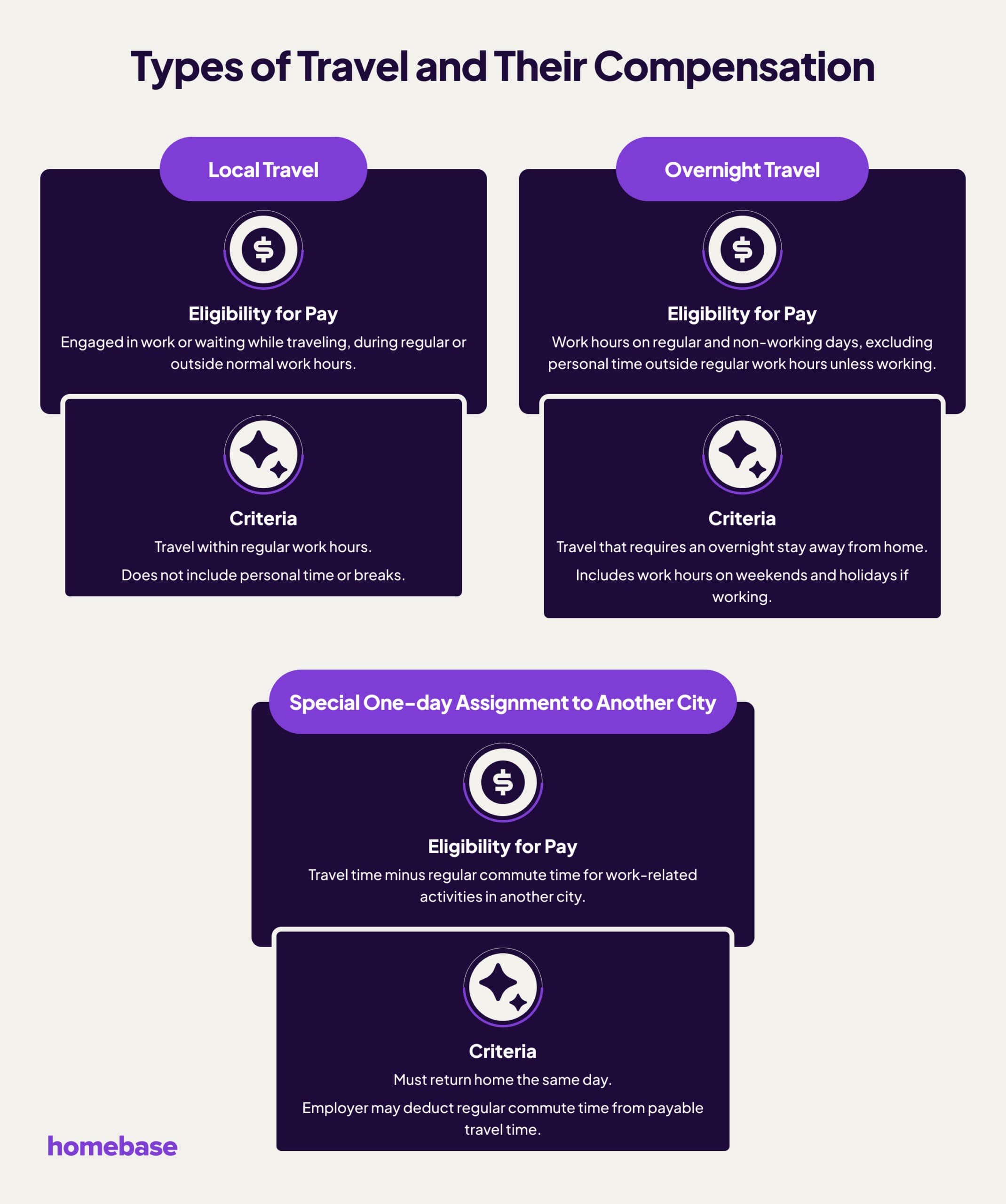
Local travel
Your employee's regular commute doesn't count. The Portal-to-Portal Act says ordinary home-to-work travel at the start and end of the day is unpaid time.
But travel between job sites during the workday? That's paid. If your employee drives from one work location to another as part of their job, you're paying for that time—even if those locations are in different cities.
You're paying for:
- Travel during regular work hours
- Travel between work locations or job sites
- Travel while doing work (like a delivery driver making stops)
You're not paying for:
- Regular commute to the first work site
- Commute home from the last work site
Travel between job sites counts toward that 40-hour overtime threshold. Employee works 38 hours at your main location and spends 4 hours driving between client sites? That's 42 total hours—with 2 hours at overtime rates.
Example: A personal assistant drives a client around town running errands during work hours. Since this travel is part of their job duties and happens during scheduled work time, it's compensable.
Special one-day assignment to another city
Sending an employee to a conference, meeting, or training in another city for the day? You're paying for their travel time to and from that city—but you can subtract their normal commute time.
The math: Calculate total travel time, subtract normal commute time, and what's left counts as hours worked.
If this pushes them over 40 hours for the week, overtime rates apply.
Example: Your employee works in your office. You send them to a conference in another city, and they return the same day. Roundtrip takes two and a half hours. Their regular daily commute is 30 minutes. You deduct the 30-minute commute and pay them for two hours of travel time.
Overnight travel
This gets complicated—and it's where most overtime surprises happen.
Travel during regular work hours (even on weekends): If your employee travels during their normal working hours, that's compensable time—even if it's Saturday. Employee normally works 9am-5pm Monday through Friday, then flies to a conference on Saturday at 10am? Those travel hours during their regular 9am-5pm window get paid.
This applies whether they're working during travel or just sitting on a plane.
Travel outside regular hours: Travel outside normal work hours is generally not compensable—unless they're doing work during that time. Responding to emails, preparing presentations, or taking client calls during travel? That makes it compensable.
Does travel time count toward overtime?
When travel time qualifies as hours worked, it counts toward your weekly total for overtime. If travel pushes an employee over 40 hours in a workweek, you must pay overtime rates (1.5x the regular rate) for hours over 40.
The FLSA requires overtime pay for all hours worked over 40 in a workweek, including compensable travel time. Many small business owners assume travel is separate from regular work when calculating overtime—it's not.
Example: An employee works their regular 40-hour week Monday through Friday, then travels 8 hours on Saturday during their normal work hours for a Sunday conference. Those 8 Saturday hours are compensable travel time. Total for the week: 48 hours. You pay a regular rate for the first 40 hours and overtime rates (1.5x) for the remaining 8 hours.
How to calculate travel time pay for hourly employees
Once you know travel time is compensable, here's how to handle payment:
1. Track actual hours
The simplest approach: track and pay employees for actual time spent traveling between job sites or client locations. Pay them at their regular hourly rate (or a different rate that meets minimum wage).
Remember: Travel time counts toward overtime. If total hours—including travel—exceed 40 in a workweek, overtime rates (1.5x) apply to hours over 40.
2. Apply overtime rates when needed
Yes, you must pay overtime for travel time if it pushes an employee over 40 hours.
Under the FLSA, compensable travel time counts as hours worked. When total hours (including travel) exceed 40 in a week, you pay 1.5x the regular rate for hours over 40.
Example: Employee works 38 regular hours at your shop, then travels 6 hours overnight during their normal work hours for a trade show. Total: 44 hours. You pay regular rate for the first 40 hours and overtime rate (1.5x) for the remaining 4 hours.
This trips up a lot of business owners. Travel isn't separate from regular work when calculating overtime—all compensable hours count together.
3. Consider flat rates carefully
Some employers pay a fixed flat rate for travel regardless of actual hours. This can simplify payroll, but watch out: any flat rate must meet minimum wage requirements and account for overtime when total hours exceed 40.
If an employee’s flat rate divided by actual hours falls below minimum wage, or if it doesn't provide overtime pay for hours over 40, you're not compliant.
Check their payroll or talk to legal counsel before setting up flat rate arrangements.
Homebase tracks all your team's hours—including travel time—and handles the overtime calculations automatically when you run payroll. No spreadsheets, no math errors.
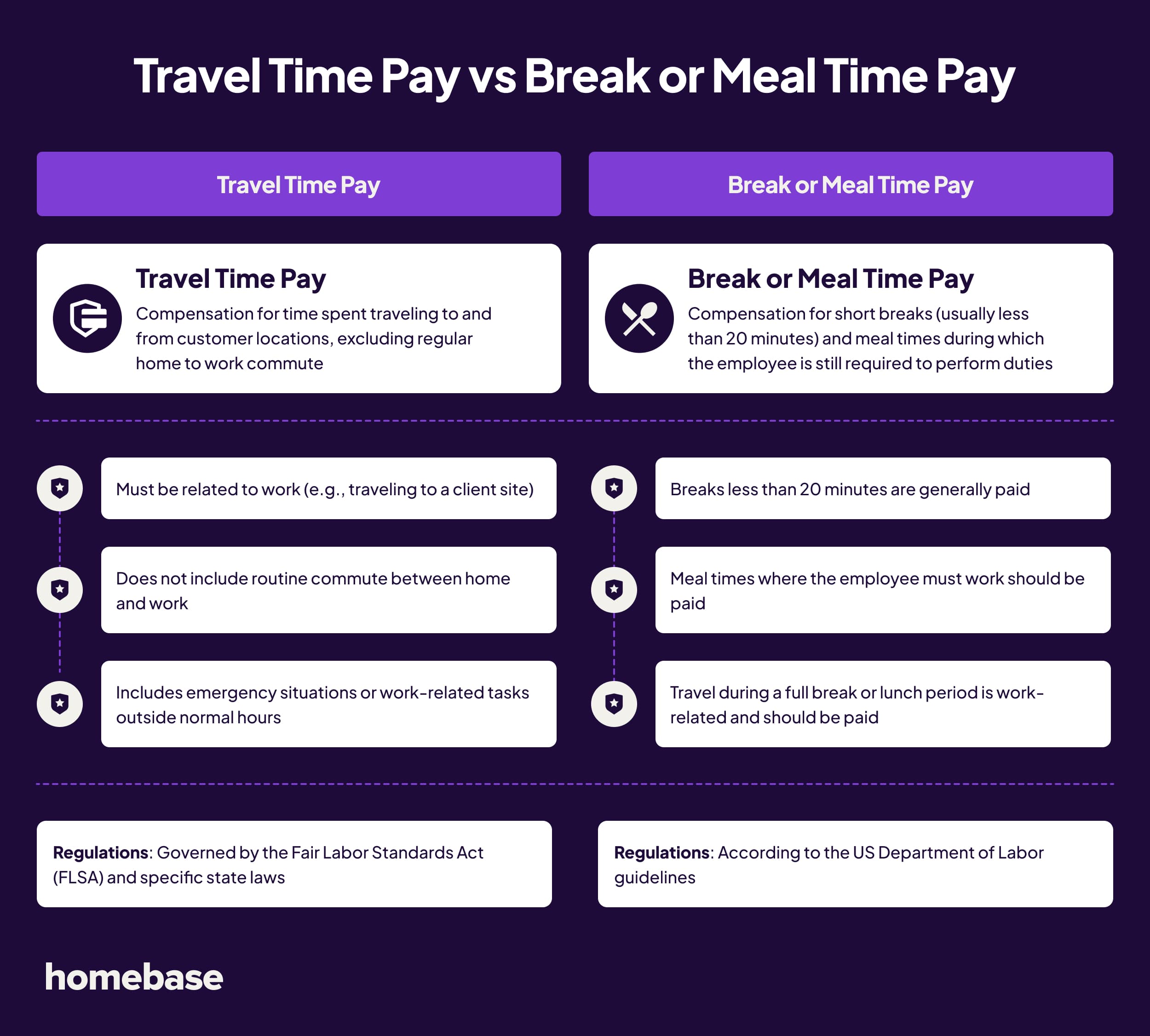
Travel time vs. break time: what's the difference?
Travel time rules and break rules are separate under the FLSA.
Short breaks (under 20 minutes): Must be paid. These are covered under 29 CFR 785.18.
Meal breaks (30+ minutes): Can be unpaid if the employee is completely relieved of work duties.
Travel during breaks: If you ask an employee to travel during their lunch break, that travel time is work-related and must be paid.
Travel time rules are covered under 29 CFR 785.35-41, while break time falls under different FLSA provisions. Keep a clear policy that explains how lunch breaks and rest periods are handled separately from travel time.
Travel time pay rate law by state
The FLSA sets the federal baseline, but your state might require you to pay more. When federal and state rules differ, follow whichever law is better for employees.
Here's what you need to know about travel time pay in states with specific requirements:
California
California goes further than federal law when it comes to travel time. Any travel that exceeds your employee's normal daily commute counts as work time and must be paid. You can set a different rate for travel versus regular work, but it can't drop below minimum wage.
The big difference: California has daily overtime rules. If travel pushes someone over 8 hours in a single day, overtime rates kick in—not just at the 40-hour weekly mark. Learn more from the California Department of Industrial Relations.
New York
New York generally follows FLSA travel time rules. Travel between job sites during the workday is paid time. Travel during an employee's normal work hours (even on weekends) must be compensated. And yes, travel time counts when calculating overtime.
The state Department of Labor confirms that work-related travel is compensable time under state minimum wage regulations.
Oregon
Oregon breaks travel into four categories:
- Portal-to-portal (home to work): Not paid
- Travel between worksites during the day: Paid
- Special one-day assignments: Paid
- Overnight travel during normal work hours: Paid
Oregon's rules closely mirror federal law, but the state requires payment when employees travel between multiple work sites to complete their day's work. Check the Bureau of Labor and Industries for current guidance.
New Jersey
New Jersey follows FLSA standards. Travel between job locations during the workday must be paid at the employee's regular rate. Travel time counts toward the 40-hour overtime threshold.
Delivery drivers, home healthcare aides, and other mobile workers are entitled to payment for travel time between client locations. Visit the New Jersey Department of Labor for more details.
Maryland
A 2022 Maryland Court of Appeals ruling (Amaya v. DGS Construction) clarified that employees may be entitled to pay for travel time when employers require them to report to a designated parking area and take a shuttle to the work site. The court ruled this travel time counts as compensable work because the parking lot serves as a "prescribed workplace."
This ruling matters if you require employees to use employer-provided transportation to reach job sites. Maryland hasn't adopted the federal Portal-to-Portal Act, so state rules may be more generous than federal law.
Nevada
Nevada requires employers to pay at least minimum wage for travel between work sites during the workday and when employees transport other employees on behalf of the employer. Regular commuting from home to work is not paid.
Recent updates (2025) aligned Nevada law more closely with federal FLSA standards. Check the Nevada Labor Commissioner for current requirements.
Your state not listed? Most states follow federal FLSA rules. Check your state's Department of Labor website for any additional requirements beyond federal law.
How Homebase can help calculate work travel time
Tracking travel time doesn't have to mean spreadsheets and calculator anxiety. Homebase handles the math automatically for teams that work across multiple locations.
What Homebase does for travel time tracking:
- GPS time clocks capture when and where your team clocks in—including travel between job sites
- Different pay rates let you pay one rate for travel, another for regular work, without manual calculations
- Overtime alerts warn you before anyone hits 40 hours, so you can adjust schedules instead of facing surprise costs
- One-click payroll converts timesheets to payroll data instantly—integrates with QuickBooks, Gusto, and more
Stop worrying about FLSA compliance and overtime mistakes. Track travel time accurately from day one with Homebase Payroll.
Homebase makes payroll painless.
Onboard employees, track their time, and pay them — all in one place.
Travel Time Pay FAQs
Does travel time count as hours worked?
Yes, travel time counts as hours worked when it happens during the workday or involves job-related activities. Under the FLSA, you must pay for travel between job sites, travel during an employee's regular work hours (even on weekends), and any travel where employees perform work duties.
Regular home-to-work commuting doesn't count as hours worked under the Portal-to-Portal Act.
Does travel time count toward overtime?
Yes, travel time counts toward overtime when it qualifies as hours worked. If an employee's total hours—including compensable travel time—push them over 40 in a workweek, you owe overtime rates (1.5x their regular rate) for every hour over 40. The FLSA treats travel hours and regular work hours the same way when calculating overtime.
Do employers have to pay hourly employees for travel time?
Employers have to pay hourly employees for travel time depending on the type of travel. You must pay non-exempt employees for travel between job sites during the workday, travel during their regular work hours, and special one-day trips to other cities (minus their normal commute time).
Regular home-to-work commuting isn't paid under the FLSA, though your state might require more.
What is the Portal-to-Portal Act?
The Portal-to-Portal Act is federal law that defines which activities count as compensable work time under the FLSA. It says ordinary commuting from home to work at the start and end of each workday isn't paid time. But once employees are on the clock, travel between job sites during the workday must be paid.
How do you calculate travel time for hourly employees?
Calculate travel time for hourly employees by tracking actual hours spent on compensable travel and including those hours in their weekly total. If their combined work and travel hours exceed 40 in a week, pay overtime rates (1.5x) for hours over 40.
For one-day trips to other cities, subtract their normal commute time from total travel time to get compensable hours.
Do hourly employees get paid while traveling?
Hourly employees get paid while traveling when it happens during their regular work hours or as part of their job duties. Travel between job sites during the workday is always paid. Travel during someone's normal 9am-5pm schedule—even if it's Saturday—is compensable.
Regular commuting and overnight travel outside normal hours (when they're not working) aren't paid.
Does flight time count as hours worked?
Flight time counts as hours worked if it occurs during an employee's regular work schedule or if they're performing work duties during the flight. When someone normally works 9am-5pm Monday through Friday, and they fly during those hours on Saturday for a Sunday conference, that flight time is compensable.
Flight time outside regular hours generally isn't paid unless they're actively working.
What is compensation time for travel?
Compensation time for travel refers to the hours employees are paid for when traveling for work under FLSA rules. In the private sector, you must pay non-exempt employees in actual wages for compensable travel time—you can't substitute time off later. Comp time arrangements (trading paid hours for future time off) are only allowed for public sector employees.