How to Pay Yourself from an LLC: The Complete 2026 Guide


SMALL BUSINESS INTEL, IN YOUR INBOX
Table of contents
Remember that exciting moment when you landed your first big client or made your first sale? You were probably focused on growing your business, not thinking about the mechanics of paying yourself. But now that money's flowing into your LLC's bank account, you're wondering how to actually get that money into your own pocket.
It's not as complicated as it seems. The way you'll pay yourself depends on your LLC's setup: whether you're flying solo, have business partners, or have opted for S corporation status. This guide walks through exactly how to pay yourself from an LLC so you can do it correctly and keep the IRS happy.
For a broader look at how owners across all business structures pay themselves, check out our guide on how to pay yourself as a business owner. This post focuses specifically on small business taxes and payment rules for LLCs.
TL;DR: How Do Owners Pay Themselves in an LLC?
When it comes to how to pay yourself from an LLC, there's no one-size-fits-all approach. How do LLC owners get paid? It depends on how your LLC is set up. Here are your three main options:
- Owner's draw: The most common method for single-member LLCs. An owner's draw LLC owners use means transferring money from business profits as needed. You'll owe self-employment tax (15.3% in 2026) on net profit, not just what you withdraw.
- Guaranteed payments: In a guaranteed payments LLC structure, members receive a fixed payment regardless of the business's profitability.
- Salary: Required if your LLC is taxed as an S corporation. You run payroll, withhold taxes, and can take additional profit distributions.
No matter which method applies, set aside 25–30% of everything you take for taxes. Quarterly estimated taxes for LLC owners are your responsibility, not your employer's.
TL;DR: How Do Owners Pay Themselves in an LLC?
When it comes to how to pay yourself from an LLC, there's no one-size-fits-all approach. How do LLC owners get paid? It depends on how your LLC is set up. Here are your three main options:
- Owner's draw: The most common method for single-member LLCs. An owner's draw LLC owners use means transferring money from business profits as needed. You'll owe self-employment tax (15.3% in 2026) on net profit, not just what you withdraw.
- Guaranteed payments: In a guaranteed payments LLC structure, members receive a fixed payment regardless of the business's profitability.
- Salary: Required if your LLC is taxed as an S corporation. You run payroll, withhold taxes, and can take additional profit distributions.
No matter which method applies, set aside 25–30% of everything you take for taxes. Quarterly estimated taxes for LLC owners are your responsibility, not your employer's.
How to Pay Yourself in a Single-Member LLC
If you're running your LLC solo, this is probably your setup. As a single-member LLC owner, you're not considered an employee. Instead, you transfer profits from your business account to your personal account through what's called an owner's draw.
Here's what that means for your taxes in 2026:
- No payroll withholding on draws. You pay self-employment tax and income tax on profits yourself.
- The 2026 SE tax rate is 15.3%: 12.4% for Social Security on the first $184,500 of net earnings, and 2.9% for Medicare with no cap.
- The IRS only taxes 92.35% of your net profit, not the full amount. That's a built-in adjustment for the employer half that W-2 employees don't pay themselves.
- You can deduct half of your SE tax from your adjusted gross income. It's an above-the-line deduction available whether or not you itemize, which lowers your income tax bill.
Here's what that looks like in real numbers. If your LLC nets $80,000 this year, SE tax applies to $73,880 (92.35% × $80,000). At 15.3%, that's roughly $11,304, or about $2,826 per quarter. Set up a dedicated savings account for this before you take your first draw.
At tax time, you'll report everything on Schedule C with your personal return. The IRS sees your business profits as your personal income automatically. You're treating a disregarded entity as an extension of yourself for tax purposes.
How to Pay Yourself in a Multi-Member LLC
In a multi-member LLC, how LLC owners get paid depends on two options. Multi-member LLCs default to partnership tax treatment, so members report their share of income on their own personal tax returns.
Profit distributions come from your ownership percentage. If you own 60% of the LLC, you get 60% of the profits. Key details:
- Based on your operating agreement
- Generally subject to self-employment tax for active members. The IRS treats active LLC members like general partners, so your distributive share of profits is typically SE-taxable
- Not guaranteed: if the business has a slow month, distributions can shrink or be skipped
Guaranteed payments compensate you for the work you do, regardless of profitability. Key details:
- Paid before profits are distributed
- Deductible for the LLC as a business expense
- Also taxed as self-employment income for the recipient
In both cases, transfer payments from your business account to your personal account. Since you're not an employee, handle taxes yourself through quarterly estimated payments. At year-end, you'll get a Schedule K-1 showing both types of income for your tax return.
Can a Single-Member LLC Pay Themselves a Salary?
Technically, you can't pay yourself a traditional salary from a single-member LLC unless you've elected to be taxed as an S corporation.
The IRS already considers you and your single-member LLC to be one and the same for tax purposes. You're not an employee; you're the owner. That means all the profits flowing through your business are automatically considered your personal income.
So how do you get paid? You take what's called an "owner's draw." Think of it like reaching into your business cookie jar. In practice, it's a transfer from your business account to your personal account. Make sure to:
- Label these transfers clearly as "Owner's Draw" in your books
- Keep detailed records of when and how much you take
- Set aside roughly 25–30% for taxes
Why single-member LLC owners can't run payroll for themselves.
The IRS treats a single-member LLC as a disregarded entity. You and your LLC are the same taxpayer. Without electing S corporation status, single member LLC payroll for the owner isn't possible, and any attempt to treat your draws as W-2 wages creates serious compliance problems.
This is a detail that trips up a lot of owners when they switch payroll systems, too. As Cambria Wallace, Project Lead of Payroll Operations at Homebase, puts it:
"Starting a new payroll system does not mean starting 'fresh.' If payroll was previously run under your company's EIN within the same year, those wages and taxes must still be reported and filed." — Cambria Wallace, Project Lead, Payroll Operations, Homebase
When an S corp election makes sense for LLC owners.
If you've elected S corporation status via Form 2553, you must pay yourself a reasonable salary as a W-2 employee. This means running payroll and withholding taxes. Beyond your salary, you can take additional profit distributions that aren't subject to self-employment tax, which is the core tax advantage.
Most CPAs put the break-even range at 60,000–80,000 in net profit annually. Below that, the cost and complexity of running payroll and filing Form 1120-S typically outweighs the savings. Above it, the math usually tips in favor of electing. Your income shows up on two forms: your W-2 for salary and Schedule E for distributions.
What "reasonable compensation" means for S corp LLC owners.
The IRS requires S corp owner-employees to pay themselves a market-rate W-2 salary before taking profit distributions. If you're wondering whether you can pay yourself a salary from your LLC, the answer is yes, but only after electing S corp status. "Reasonable" means what you'd pay an unrelated employee to do the same work in the same market. The 2026 Social Security wage base is $184,500, which applies to both SE tax and W-2 wages.
You'll want to benchmark your salary before setting up payroll. The Bureau of Labor Statistics Occupational Outlook Handbook, Glassdoor, and Salary.com are all useful starting points. Per IRS guidance on S corporation officer compensation, the standard is based on your duties, experience, hours, and what comparable businesses pay.
A few things worth clearing up:
- The 60/40 rule is a myth. The idea that you should pay yourself 60% as salary and take 40% as distributions has no IRS basis. It's a popular shorthand, but auditors won't accept it as a rationale.
- Red flags that trigger scrutiny: suspiciously low salary paired with large distributions, inconsistent bookkeeping, or mixing personal and business expenses.
Running payroll for yourself for the first time shouldn't require an accounting degree. When your LLC grows to the point of setting up payroll, the right tool handles the tax math, files automatically, and sends direct deposits so payday runs without you spending hours on it. See how payroll works for small businesses.
Bradley Cooke, Executive Director of Forebay Aquatic Center, runs payroll for a team that grows from three to 25 employees each summer. He's not an accountant, and for years, payroll was the most stressful part of his job:
"I was counting on them to just make this easy for me, and it was never easy. I was exasperated." — Bradley Cooke, Executive Director, Forebay Aquatic Center
After switching to Homebase, he cut payroll management costs 30% and now runs payroll in 30 minutes, compared to a process that used to involve driving to a physical office to sort out mistakes.
How Do I Pay Myself from a Multi-Member LLC?
Running a business with partners adds some wrinkles to how you get paid. Your two main options are guaranteed payments and profit distributions.
Guaranteed payments: your "salary" alternative. Think of guaranteed payments as your compensation for showing up and doing the work. Maybe you're managing day-to-day operations or bringing in most of the clients. Guaranteed payments ensure you get paid for your effort, regardless of whether the business is profitable that month. These payments:
- Are similar to a salary, but you're still not an employee
- Get paid before profits are distributed
- Are tax-deductible for the LLC
- Count as self-employment income for the recipient, meaning SE tax applies
Profit distributions: your share of the pie. This is where your ownership percentage comes into play. If you own 40% of the LLC, you're entitled to 40% of the distributed profits. A few important notes:
- They're based on your operating agreement
- They usually happen quarterly or monthly
- They aren't guaranteed
- Partners can agree to reinvest profits instead of distributing them
- For active members, distributions are generally subject to SE tax, so confirm your specific situation with a tax advisor
How to handle the money and taxes:
- Set up regular transfers from your business account to your personal account
- Keep detailed records of both guaranteed payments and distributions
- Plan for quarterly estimated tax payments
- Expect a Schedule K-1 at tax time showing both types of income
Pro tip: work with your partners to create a written payment schedule. Having clear expectations about when and how much everyone gets paid can prevent a lot of headaches.
What Is the Most Tax-Efficient Way to Pay Yourself in an LLC?
It depends entirely on your LLC's profits. The best way to pay yourself from LLC earnings when you're making less than 60,000–80,000 annually is to stick with the default owner's draw setup. The administrative costs of other options usually outweigh the benefits, and the break-even point varies by state and industry, so run the math with your accountant first.
Once you're consistently clearing that range, electing S corporation status typically makes the most sense. You pay yourself a reasonable salary, which is subject to self-employment tax, and take the rest as distributions, which aren't. That gap can translate into meaningful savings.
Just remember that "reasonable" is the key word. The IRS pays close attention to suspiciously low salaries paired with large distributions.
What Taxes Do I Pay When I Pay Myself from My LLC?
Taxes are probably the least fun part of running your business. For most LLC owners, LLC self-employment taxes and regular income tax are the two main bills you'll face.
In 2026, self-employment tax is 15.3%: 12.4% for Social Security on the first $184,500 of net profit, and 2.9% for Medicare with no cap. High earners above $200,000 (single) or $250,000 (married filing jointly) also owe a 0.9% Medicare surtax on income above those thresholds. Since you're wearing both hats, you're paying both the employer and employee portions of these taxes.
Plan to set aside 25–30% of everything you earn for taxes. For LLC owners, quarterly estimated taxes come due four times a year. The 2026 due dates are:
- April 15, 2026: for income earned January through March
- June 15, 2026: for income earned April through May
- September 15, 2026: for income earned June through August
- January 15, 2027: for income earned September through December
For full guidance on calculating and making estimated payments, see IRS Publication 505. Keep a separate savings account just for taxes. You'll thank yourself later.
When it comes to payroll taxes specifically, your structure determines who's responsible for what. If you elect S corp status, you and the business split FICA on your salary, just like any employer-employee relationship.
How to Transfer Money from Your LLC to Your Personal Account
The mechanics of getting paid through an LLC are straightforward. When you transfer money from LLC to personal account, you can use an ACH transfer, check, or your bank's online transfer system.
The key is consistency and clear documentation. To transfer money from your LLC to your personal account, label every transaction as either "Owner's Draw" or "Distribution" in your accounting app or bookkeeping tool. Most business owners set up a regular payment schedule on the 1st and 15th of each month. Whatever method you choose, keep it separate from personal expenses. No using the business debit card for personal purchases, even if you plan to "pay it back later."
For S corp owners, the mechanics are different. You set yourself up as a W-2 employee in your payroll system and run payroll on a regular schedule. You receive a direct deposit just like any team member. The owner's draw and the payroll run are separate actions. Your payroll system handles withholding, so you're not responsible for calculating estimated taxes on the salary portion the way default LLC owners are.
This is also where switching payroll providers can create complications. When you change systems, the new tool isn't starting from zero. Any wages and taxes already reported under your EIN that year still need to be filed and accounted for. Switching payroll providers mid-year requires careful coordination to make sure nothing falls through the cracks.
How to do payroll is a separate question from how to pay yourself, but the two connect once your LLC starts paying a team. Understanding both gives you the full picture.
What Percentage Should I Pay Myself from My LLC?
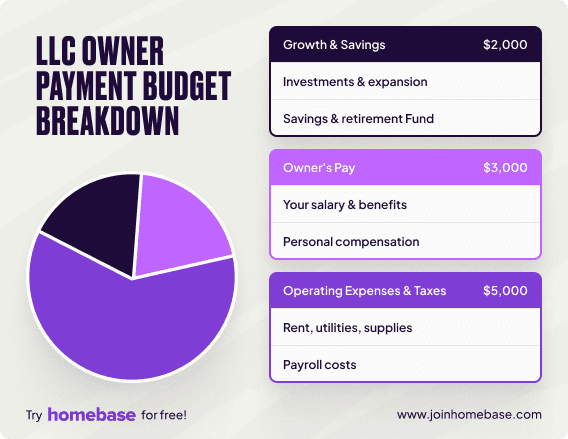
There's no magic percentage. The best way to pay yourself from an LLC depends entirely on your business's cash flow and growth goals. An owner's draw from an LLC is flexible, but a good starting point is the 50/30/20 rule:
- 50% for operating expenses, including taxes
- 30% for owner's pay
- 20% for reinvesting in growth
But these numbers shift based on your industry and stage.
For example, if you're bringing in $10,000 monthly:
- Set aside $5,000 for expenses and taxes
- Pay yourself $3,000
- Keep $2,000 for business growth or your rainy-day fund
For business owners with hourly teams (restaurants, retail stores, salons), the picture looks a little different. Labor costs typically run 25–35% of revenue before the owner sees a dollar. That compresses the 30% owner-pay target significantly. Many hourly-team owners realistically draw 15–20% in their early years while protecting cash reserves and covering team payroll. That's not a failure of the business, it's the reality of running one that depends on people.
As your business becomes more stable, you can gradually increase your percentage. Always keep enough cash in the business to cover at least three months of expenses.
Keeping close track of labor costs is the practical prerequisite for knowing what you can afford to draw. When payroll is connected to scheduling and time tracking, you can see the full picture before committing to a draw. Explore how Homebase approaches payroll for small businesses.
How Do I Report LLC Income on My Personal Taxes?
Tax reporting varies based on how your LLC is structured.
With a single-member LLC, report all your business income and expenses on Schedule C of your personal tax return. The IRS treats your business as an extension of yourself, so everything flows through to your 1040.
Multi-member LLCs and S corps are a bit different:
- In a multi-member LLC, you'll receive a Schedule K-1 showing your share of profits and losses
- For S corps, you'll get both a W-2 for your salary and a K-1 for any additional distributions
Keep these forms organized. Your tax app or accountant will need them to properly report your business income.
What Happens If an LLC Makes No Money?
Starting or running a business during lean times doesn't mean you can't pay yourself anything. But it does mean you need to be strategic. If your LLC isn't profitable, any money you take out is considered a draw against your ownership equity or a loan to yourself. While this is legal, it's not sustainable and could create tax complications.
Your best move during unprofitable periods is to minimize personal draws and focus on building revenue. Document any money you put into the business as a capital contribution. This creates a clear paper trail for when your business becomes profitable again. Consider consulting work or other income sources to cover personal expenses until your LLC gets back on track.
Start Paying Yourself from an LLC the Right Way
Now you know the basics of how to pay yourself from an LLC:
- Single-member LLCs take owner's draws
- Multi-member LLCs use guaranteed payments and distributions
- S corps balance salary with distributions
Start with a clear payment structure based on your LLC type, keep detailed records, and always set aside money for taxes.
Run major financial decisions by your accountant, especially if you're considering switching to S corp status. And no matter which payment method you choose, maintain strict separation between business and personal finances.
Once your LLC starts growing and you're ready to bring on a team, payroll becomes a whole new layer. Bradley Cooke of Forebay Aquatic Center knows that feeling well. After years of stressful payroll runs with a provider that made things harder than they needed to be, he made the switch:
"I'm not concerned about payroll problems anymore. I don't have that stress on my mind. I can play with my dog more. That's super simple, but super positive, and it's worth a lot to me." — Bradley Cooke, Executive Director, Forebay Aquatic Center
When your LLC is ready to pay a team, tracking hours, calculating wages, and filing taxes automatically means payday is one less thing keeping you up at night. See how Homebase handles payroll for small businesses.

Make payroll painless.
Auto-convert timesheets into wages, catch errors, pay your team, and file taxes all in one place.
Frequently Asked Questions About Paying Yourself from an LLC
Can a single-member LLC pay themselves a salary
Without an S corporation election, a single-member LLC owner cannot pay themselves a W-2 salary. You and your LLC are the same taxpayer in the IRS's view, so your payment method is an owner's draw, not payroll. Filing Form 2553 to elect S corp status changes this, and requires you to run payroll and pay yourself a reasonable market-rate salary.
Can LLC owners be on payroll
LLC owners can only be on payroll if the LLC has elected S corporation or C corporation tax treatment. Default single-member LLCs (taxed as sole proprietorships) and multi-member LLCs (taxed as partnerships) don't use payroll for owner compensation. They use owner's draws or guaranteed payments instead.
What is the most tax-efficient way to pay yourself in an LLC
For most LLC owners netting under 60,000–80,000 annually, the default owner's draw is the most efficient option. The administrative cost of other structures outweighs the savings. Once you're consistently above that range, electing S corporation status and splitting compensation between a W-2 salary and profit distributions can reduce your self-employment tax exposure significantly.
How do I pay myself from a multi-member LLC
Multi-member LLC owners pay themselves through profit distributions (based on ownership percentage) or guaranteed payments (a fixed amount for services performed). Guaranteed payments are deductible for the LLC and taxable as self-employment income for the receiving member. Both types appear on your Schedule K-1 at year end.
Can I 1099 myself from my LLC
You cannot issue yourself a 1099 from your own single-member LLC. The IRS treats a single-member LLC as a disregarded entity, so payments to yourself aren't contractor payments. They're owner's draws. See our breakdown of 1099 vs. W-2 employees for more on how these distinctions work.
Do you have to pay yourself a salary from your LLC
Default LLC owners face no mandatory salary requirement. Single-member LLCs take owner's draws, and multi-member LLCs use distributions or guaranteed payments. The exception is an LLC taxed as an S corporation: the IRS requires shareholder-employees who perform services for the business to pay themselves a reasonable W-2 salary before taking profit distributions.