How to Write an Email to Employees About Clocking In and Out


SMALL BUSINESS INTEL, IN YOUR INBOX
Table of contents
Writing an email to employees about clocking in and out is one of the most important things a small business owner can do. It's also one of the most avoided, because no one wants to sound like they're accusing their team of something.
This guide covers what a good timekeeping email needs to do, what every version of it should include, and three copy-paste templates for every stage of the conversation: introducing your policy, sending a reminder, and issuing a written warning. Then we'll get into how to make the policy stick once you've sent it.
TL;DR: How to Write an Email to Employees About Clocking In and Out
A good clock-in and clock-out email covers four things: who the policy applies to, how and where to clock in, what to do if someone forgets, and what happens if it keeps happening. Here's what else to know before you send one:
- Three templates, one for every situation. Introducing the policy, sending a reminder, and issuing a written warning all call for different tones.
- The FLSA requires it. Accurate daily and weekly time records are a federal requirement for all non-exempt employees. A policy email is the first step toward compliance.
- Automation removes the reminder loop. Once you have the right time clock tool in place, you stop sending an email to employees about clocking in and out manually. Reminders go out automatically before every shift.
Chasing missed punches every pay period? Homebase sends automatic clock-in reminders before every shift, so your team always knows when to punch in. Try it free. No credit card required.
What a Good Clock-in and Clock-out Email Actually Needs to Do
If you're not sure what to say to employees about timekeeping, start here. A clock-in and clock-out email should accomplish three things: remind your team of the policy, explain why accurate hours matter for payroll and compliance, and tell them exactly what to do (and what happens if they don't). Whether it's an introduction or a reminder, the tone should be professional and direct, not punitive.
- It sets a behavioral expectation, not just a rule. For hourly team members, clocking in accurately is directly tied to getting paid correctly. Most of them want to do it right. They just need to know what "right" looks like.
- A clear email up front saves harder conversations later. Owners who send a well-structured email and follow it up with consistent enforcement often stop having to address the issue at all. The ones who skip the email and go straight to enforcement tend to get pushback, because the expectation was never clearly set.
- Know what you're actually communicating before you write it. The sections below break down exactly what your email needs to cover.

Why Employees Fail to Clock In and Out (and What It Costs You)
Why employees forget to clock in and out.
Most missed clock-ins aren't intentional. Employees get busy, forget the step, or don't know what to do when they miss one.
But the cost adds up. Research widely cited from the American Payroll Association puts the average at nearly four hours and five minutes per employee per week in time theft. For a 25-person team paying $27 an hour, that's more than $57,000 in annual payroll loss.
The common causes are structural: no prompts, an unfamiliar system, a time clock in the wrong place, a correction process nobody knows about. Those are fixable.
The intentional ones, buddy punching, early clock-ins, extended breaks, are a different conversation and require a different response. We'll cover those later.
What missed punches actually cost you.
There's the dollar figure, and then there's the time. In a r/Restaurant_Managers discussion on missed clock-outs, one manager with 40 front-of-house team members described spending roughly 3% of their work week chasing down errors: tracking people down, getting sign-offs, correcting tip entries, fixing records before payroll closed. That's time not spent running the restaurant.
There's also a compliance risk. The Fair Labor Standards Act (FLSA) requires employers to keep accurate daily and weekly time records for every non-exempt employee. A missed punch isn't just a payroll headache. It's a recordkeeping gap. That's why a clear email to employees about clocking in and out is the first step toward fixing it. For what the FLSA specifically requires, see DOL Fact Sheet #21.
Tired of chasing employees for missed punches? Homebase sends automatic clock-in and clock-out reminders so you don't have to. Try it free.
What to Include in Your Time Clock Policy Email
A time clock policy for employees should cover: who the policy applies to, how and where they clock in, what counts as an approved break, what to do if they forget to punch, and the consequences for repeated missed punches. The clearer your expectations, the less time you spend enforcing them.
A vague email creates room for misinterpretation, and more emails later. Think of it as the foundation of a timesheet policy for hourly employees. The clearer it is, the less you'll revisit it. Here's what every timekeeping communication should address.
Which employees must clock in and out.
Be explicit. Hourly and non-exempt salaried team members must clock in and out under the FLSA. Exempt employees generally don't need to, but check your state's rules.
Something as simple as "This applies to all hourly team members at [location]" removes any ambiguity about who the policy covers.
How and where to clock in and out.
Name the specific system. "The Homebase app on your phone" or "the tablet at the front register" is more useful than "our time clock." If your team uses a PIN, photo verification, or GPS check-in, say so.
And if you're switching to a new system, walk people through the steps. Don't assume they'll figure it out. For a full breakdown of your options, see clock-in and clock-out apps and time clock kiosk setups.
Break tracking and what must be recorded.
Unpaid meal breaks need to be clocked out and back in. Paid rest breaks vary by state. California, for example, requires paid 10-minute rest breaks for every four hours worked.
Know your state's rules and say so in your email. For a closer look at break tracking for small businesses, see our dedicated guide.
What to do when an employee forgets to clock in.
This is the step most policy emails skip, and it's the one that creates the most friction.
Employees who miss a punch and don't know what to do either wait until payday (too late) or assume someone else will fix it. Give them a clear process: notify a manager immediately, don't leave the issue open until timesheets are due.
A correction procedure, manager edit plus employee acknowledgment, removes the "I forgot and didn't know what to do" excuse. You can find a full guide to timesheet errors and how to handle them.
Disciplinary action for not clocking in and out.
Keep the first email non-punitive. A line like "continued failure to clock in may result in disciplinary action" is enough. The goal is to communicate that consequences exist, not to threaten.
Save the specifics for if and when they become necessary. See our guides on employee disciplinary action and what it looks like to formally write up an employee at work.
Email to Employees About Clocking In and Out: 3 Ready-to-Use Templates
Below are three email templates covering the full communication arc: introducing your time clock policy for the first time, sending a general reminder to the team, and issuing a written warning to an individual employee. Copy, paste, and edit to fit your business. Each one is written for hourly teams.
Most situations call for a different tone. Whether you need a sample email to employees for clocking in and out or a formal written warning, here's what to use and when.
Template 1: Introducing your clocking in and out policy.
What it's for: Rolling out a new policy, onboarding new team members, or switching to a new time clock system.
Tone: Warm and informative. Focus on the "why" (accurate pay, fair scheduling) and give clear instructions.
Subject: How to clock in and out at [Business Name]
Hi team,
Starting [DATE], we're using [SYSTEM/APP] to track everyone's hours. This helps make sure we're all paid accurately and that our scheduling stays fair.
Here's how it works:
- Clock in at the start of every shift using [your PIN / the tablet at the register / the Homebase app on your phone].
- Clock out at the end of your shift and when you take unpaid breaks.
- If you forget to clock in or out, let [MANAGER NAME] know right away so we can correct it before timesheets are due.
Keeping accurate records protects everyone, including you. It ensures you're paid for every minute you work.
If you have any questions, please reach out. We're happy to walk you through it.
[Your name] [Business name]
Template 2: General reminder to clock in and out.
What it's for: A company-wide reminder email to employees about clocking in and out when missed punches are becoming a pattern, or a routine refresher before a new pay period.
Tone: Friendly but direct. Acknowledge that the team is busy, then reinforce the expectation. Don't single anyone out.
Subject: Friendly reminder: please clock in and out every shift
Hi team,
Quick reminder to clock in and out at the start and end of every shift, and for any unpaid breaks. We know it's easy to forget when things get busy, but accurate records keep payroll running smoothly and make sure you're paid correctly.
If you miss a punch, don't wait until payday. Let [MANAGER NAME] know right away so we can fix it before timesheets are due.
If you're running into trouble with [the time clock system], let us know. We're here to help.
Thanks for keeping on top of this.
[Your name] [Business name]
Customization notes: This employee clock-in reminder works just as well sent through a team communication app as it does by email.
If you're using Homebase, you can automate this reminder entirely. The app sends push notifications to team members before every shift, so you don't have to write this email at all. For more on timesheet reminders and how to set them up, see our guide.
Template 3: Written warning for not clocking in or out.
What it's for: A sample write-up for not clocking in and out, addressing a specific employee who has repeatedly missed punches after verbal reminders.
Tone: Professional, factual, and firm. Document specific dates. Keep a copy of this email on file.
Subject: Written notice, timekeeping policy compliance
Hi [EMPLOYEE NAME],
I'm following up regarding continued issues with clocking in and out. As we discussed on [DATE OF VERBAL WARNING], it's essential that you clock in at the start of each shift and clock out when you leave or begin an unpaid break.
Below are the instances where this hasn't happened:
- [DATE]: [Missing clock-in / clock-out, brief description]
- [DATE]: [Missing clock-in / clock-out, brief description]
Accurate timekeeping is required under our company policy and is essential for compliant payroll. Continued failure to follow this policy may result in formal disciplinary action.
Please confirm you've received this notice by replying to this email. If there's something making it difficult for you to clock in and out, let me know. I'm happy to work through it with you.
[Your name] [Business name]
A note on recordkeeping: Warning emails like this one are worth keeping on file for at least two to three years as a standard HR best practice. Any digital time records tied to the incident should be retained in line with FLSA requirements (three years for payroll records; two years for time cards). Most posts on this topic skip this detail entirely.
Digital time records with manager-approval workflows are significantly more defensible than paper timesheets if a dispute arises.
How to Make Your Clocking in and out Email Actually Stick
An email gets read once. Habits are built through consistent systems.
To get employees clocking in and out reliably, pair your policy communication with automated reminders, a clear correction process, and a time clock setup that makes punching in easier than skipping it.
Sending the email is the start, not the finish. Here's what makes the policy land in a way that changes behavior.
Make clocking in easier than skipping it.
If the time clock is hard to find, slow, or confusing, team members won't use it consistently. Where and how they clock in matters as much as the policy itself.
A kiosk tablet at the door, a mobile time tracking app on their own phone, or a GPS time clock app for field teams all reduce friction.
The closer the clock-in method is to where they start and end their shift, the fewer missed punches you'll deal with. For a comparison of options, see our roundup of the best employee time clock guide.
How to remind employees to clock in and out automatically.
If you're wondering how to remind employees to clock in and out without doing it manually every week, the answer is automation. Reminder emails get ignored. Automated push notifications sent five to ten minutes before a shift starts reach team members at the moment it matters.
Homebase sends automatic clock-in and clock-out reminders, flags late arrivals to managers, and catches missed punches before they reach payroll. See time clock rules for hourly employees for more on what a compliant timekeeping setup looks like.
How to fix a missed clock-in or clock-out.
One manager in a restaurant manager community discussion made a point worth repeating: missed punches are often a system problem, not a people problem.
Their team stopped relying on the POS clock as the sole source of truth and started comparing scheduled hours against actual clock records in the same view. When someone forgot to clock in, the scheduled start time was already there, and the correction took seconds instead of becoming a payroll-day dispute.
That same logic applies to how you handle inline employee time card errors and time clock rounding disputes: having scheduled hours and actual hours visible in one place makes the conversation short.
Prevent buddy punching before it starts.
Buddy punching prevention starts with understanding the problem: one employee clocks in for another who isn't there, and it's one of the most common forms of time theft on hourly teams.
Research widely cited from the American Payroll Association puts the figure at 43% of hourly employees who admit to exaggerating their hours in anonymous surveys, and buddy punching is one of the primary ways it happens.
The fix isn't punitive. It's structural.
Unique PIN codes per employee, photo verification at clock-in, and GPS-enabled location confirmation make it physically difficult for one person to clock in for another. You don't have to frame it as distrust. Frame it as protecting fairness. Everyone gets paid for exactly what they work, nothing more, nothing less. For more, see our full guide to how to stop buddy punching.
Buddy punching costs hourly teams thousands a year. Unique employee PINs and photo verification at clock-in make it structurally impossible, built right into Homebase.
Your Time Clock Policy Email and FLSA Compliance
Under the Fair Labor Standards Act, employers must maintain accurate records of daily and weekly hours worked for all non-exempt employees. The FLSA doesn't dictate a specific format, but records must be complete and accurate. Payroll records must be kept for at least three years; time cards and schedules for at least two.
Most small business owners think of the clock-in email as an operations issue. It is, but it's also a compliance issue. Here's what that means in practice:
- Time clock rules for employees under the FLSA: you must track daily start and end times, total daily and weekly hours, the regular pay rate, and overtime, for every non-exempt employee.
- States can add their own requirements. California mandates meal break tracking. New Jersey requires six years of recordkeeping. If you're unsure about your state's rules, DOL Fact Sheet #21 is the starting point, and your state's labor agency is the second call.
- Team members have the right to see their own time records. A digital system with timestamped edits and manager-approval workflows is far easier to defend than paper timesheets if a dispute comes up. A log that shows a clock-in at 8:03am, a break from 12:01 to 12:31, and a clock-out at 5:07pm leaves no room for argument. A paper timesheet that says "8 to 5" does.
- Non-compliance carries real risk: back pay, liquidated damages that can double the back pay amount, and attorney fees. The policy email doesn't just protect you from missed punches. It protects you from disputes.
For a closer look at what the law requires, see our guide to FLSA recordkeeping and time cards and how to track employee hours. The FLSA overview at the DOL is the authoritative federal source.
Clocking in and out Email vs. a Full Time Clock Policy: What's the Difference?
An email to employees about clocking in and out communicates your expectations. A formal time clock policy documents them in writing for your employee handbook. Both are necessary. The email gets read. The policy gets referenced.
Knowing how to write a clocking in and out policy helps you understand why the email alone isn't enough. Here's the practical distinction:
- The email is a communication tool. You send it when something changes, when behavior needs correcting, or when you're onboarding someone new.
- The policy is a legal document. It lives in your employee handbook, spells out the rules in full, covers break requirements and consequences for non-compliance, and can be cited if a dispute goes further.
If you don't have a written employee time tracking policy yet, the email is a good starting point. But it's not a substitute for the document itself. Our full guide to building a clocking in and out policy walks through everything a complete policy should include. See also: how to create a timekeeping policy and our attendance policy template.
How Homebase Makes Clocking in and out Automatic
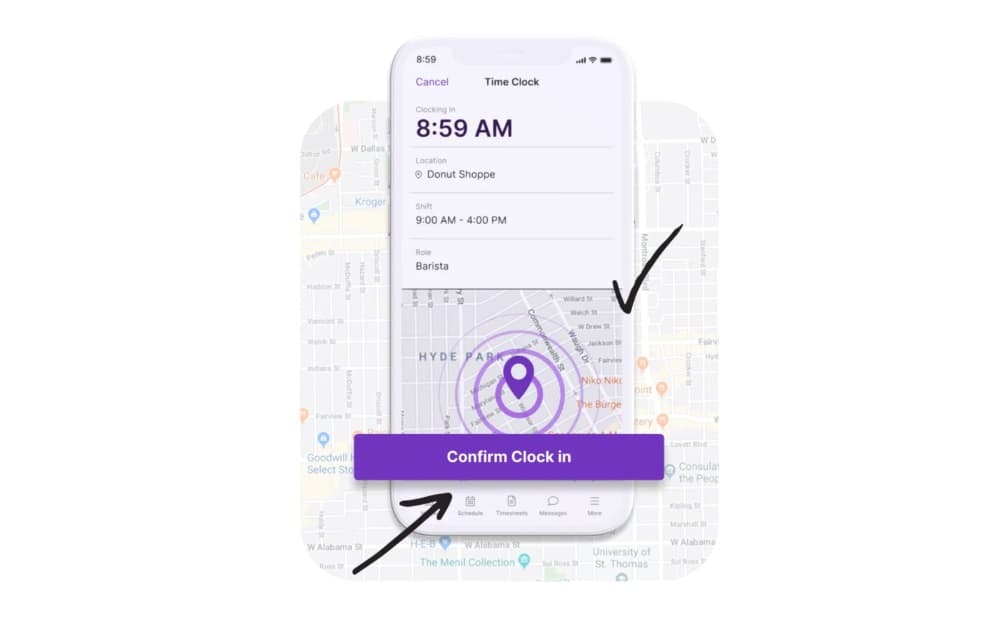
With Homebase, you can turn any phone, tablet, or POS device into a time clock. Once you've sent your email to employees about clocking in and out and set the expectation, Homebase makes the policy stick: team members clock in with a secure PIN or photo verification, automatic reminders go out before every shift, and hours flow directly into payroll-ready timesheets, no manual entry, no missed punches to chase down.
Here's what that looks like in practice:
- Automatic reminders before every shift. Team members get a push notification when it's time to clock in. No more "I forgot."
- Photo verification and unique PINs. Each team member has their own PIN, and optional photo verification confirms it's actually them. Buddy punching becomes structurally impossible.
- GPS-enabled clock-in for field teams and multi-location businesses. Homebase can flag or restrict clock-ins from outside the designated job site, so you always know where your team is punching in from.
- Auto clock-out for when someone forgets to punch out at the end of their shift, so a four-hour shift doesn't accidentally turn into a 21-hour one. (This actually happened to a Homebase customer. More on that in a moment.)
- Overtime alerts before team members hit thresholds, so you're not discovering a problem on payday.
- One-click timesheet approval that connects directly to payroll.
Bryan Tublin, co-founder of Kitava Kitchen, a four-location restaurant group in San Francisco, put it plainly:
"We needed software that could back up our practices to prove that we're doing the right thing. To show that everyone's time is being tracked, their breaks are encouraged and enforced, and that people are paid for what they work."
That's the real job the time clock does. Not just tracking hours, but creating a verifiable record that the business is operating correctly. Bryan also described a specific moment: Homebase flagged a time card showing a 21-hour shift, which turned out to be a missed clock-out.
He was able to pull up the record and show his manager exactly how to spot and fix that kind of error themselves. Read the full Kitava Kitchen case study to see how they scaled to four locations on one set of processes.
For more on how employee timesheets connect to payroll, and how to move away from manual tracking, see our guides on small business time tracking and the free time clock Homebase offers.
Stop sending the same reminder email every month. Homebase handles it automatically and turns every clock-in into a payroll-ready timesheet. Get started free.
Frequently Asked Questions About Clocking In and Out
What should I say to employees about clocking in and out?
When writing an email to employees about clocking in and out, keep the tone professional, clear, and non-accusatory. Explain how the policy works, why accurate time tracking matters for payroll, and what to do if they miss a punch.
The templates in this post cover every scenario, from introducing the policy for the first time to issuing a formal written warning.
How do I remind employees to clock in and out without nagging?
To remind employees to clock in and out without nagging, send one clear policy email, then automate the follow-up. Homebase sends automatic push notifications before each shift so team members don't forget.
Framing reminders around accurate pay, not punishment, also improves compliance without creating resentment.
What should a time clock policy email include?
A time clock policy email should include: who must clock in, how and where to do it, how to handle missed punches, break tracking requirements, and consequences for non-compliance. The clearer the email, the less room there is for "I didn't know." A linked written policy adds a permanent reference point.
Can I write up an employee for not clocking in?
Writing up an employee for not clocking in is appropriate, but document each step. Start with a verbal reminder, follow with a written email on file, and escalate if the issue continues.
Apply the same standard to everyone. The warning template in this post is designed as a formal record you can reference if the issue escalates.
What are the FLSA rules for clocking in and out?
The FLSA rules for clocking in and out require employers to keep accurate daily and weekly time records for all non-exempt employees. Records must be complete and accurate, but the FLSA doesn't mandate a specific format.
Payroll records must be retained for at least three years; time cards and schedules for at least two.
Does every employee have to clock in and out?
Hourly employees and non-exempt salaried workers must clock in and out under the FLSA. Exempt employees, those who meet salary and duties thresholds, generally don't.
If you're unsure whether an employee is exempt, check the FLSA guidelines at dol.gov or consult your state's labor agency.