
.jpeg)
If you're doing HR manually: tracking time in spreadsheets, chasing down onboarding paperwork at midnight, or running payroll by hand, the right HR software for small business can give you that time back.
This guide covers five of the best options for 2026, each picked for a different use case, with verified G2 and Capterra ratings, real pricing, and honest trade-offs. We focused on tools built for teams under 100 employees, and paid extra attention to businesses with hourly workers. We cover Homebase separately below, so you get an unbiased look at the rest of the market first.
The Best Small Business HR Software at a Glance
The best HR software for small business depends on whether you need payroll-first, people-first, or an hourly-team-first approach. Here's how the top small business HR software options break down.
- Best payroll-first HR for small business: Gusto
- Best HRIS for growing teams: BambooHR
- Best for HR + IT automation (50–200 employees): Rippling
- Best for deskless and hourly teams: Connecteam
- Best flat-rate payroll + HR for restaurants and retail: OnPay
Running payroll and scheduling separately is costing you time you don't have. Try Homebase free. It was built specifically for small businesses with hourly teams.
What Is HR Software for Small Business?
HR software for small business automates the people-management tasks most owners handle manually, without needing a dedicated HR department:
- Hiring and onboarding
- Time tracking and scheduling
- Payroll and tax filings
- Compliance and employee records
The right choice depends on which gap is eating the most of your time. If you're starting from scratch, how to set up HR for a small business is worth reading before you start comparing tools.
What HR Software for Small Business Does for Hourly Teams
HR software for small business with hourly teams typically covers six things: scheduling, time tracking, payroll, onboarding, compliance (I-9, FLSA, and state break laws), and team communication. For hourly teams specifically, the features that matter most are GPS-verified time clocks, automated overtime calculations, and payroll integrations that cut out manual data re-entry between systems.
Salaried office teams and hourly teams need different things from their HR tools. If most of your employees clock in and out, here's what to look for.
The best HR and payroll software for small business with hourly workers covers all of the following:
- Scheduling. Shift-based, drag-and-drop schedule building with mobile access for employees
- Time tracking. GPS clock-in, geofencing, and mobile time clocks that verify location
- Payroll. Automated processing for hourly and tipped workers, multi-state tax filing
- Onboarding. Digital I-9 and W-4 collection, document storage, new hire workflows
- Compliance. FLSA overtime rules, state break laws, minor labor law age restrictions
- Communication. Team messaging, shift coverage requests, and company announcements
For more on the HR services small businesses need by stage of growth, see our full guide.
How to Choose HR Software for Small Business
When choosing HR software for a small business, start with your biggest pain point: payroll accuracy, scheduling chaos, onboarding paperwork, or compliance exposure. Then ask three questions: does the pricing scale with your headcount? Does it connect to the payroll or accounting tools you already use? And will your hourly employees actually pick up the mobile app?
Most HR management software for small business is built for companies that already have an HR team. If you're the HR team, here's how to find something that actually fits.
Match the tool to your team type:
- Hourly or field-based teams — need GPS time tracking, scheduling, and payroll in one place. Connecteam and Homebase are purpose-built for this.
- Salaried or mixed teams — need an HRIS with onboarding, PTO tracking, and reporting. BambooHR is a common fit.
- Fast-growing teams (50+) — benefit from HR and IT automation together. Rippling handles both.
Match the tool to your headcount:
- Under 10 employees — Connecteam's free tier is a solid starting point.
- 10–50 employees — Gusto or OnPay cover most payroll and HR needs cleanly.
- 50–200 employees — Rippling's automation starts to earn its cost.
Must-have checklist before committing:
- Free trial or free tier available, so your team can try the mobile app before you pay
- Mobile time clock with GPS or geofencing for hourly workers
- Compliance features that cover your state's break laws and overtime rules
If you're weighing outsourcing HR against buying software, or looking into a professional employer organization, our guides cover both.
One thing worth knowing: in a r/workforcemanagement thread on HR software for small teams, multiple owners said they went live on a full-featured tool and ended up spending more time managing it than using it. The advice that kept coming up: solve the one gap that's costing you the most time first, and add complexity later.
Why Trust Homebase's HR Software for Small Business Guide
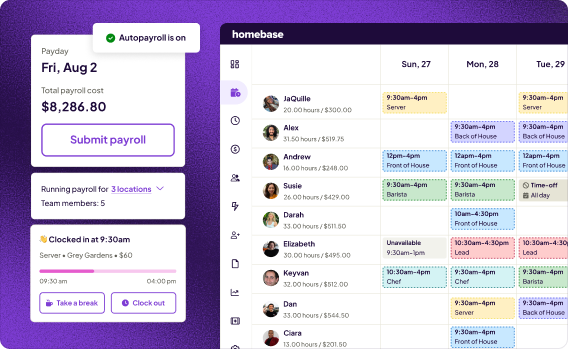
Homebase works with 150,000+ small businesses with hourly teams, from restaurants and retailers to home service companies and field crews. Our HR software for small business recommendations are shaped by the specific challenges these businesses face every day: unpredictable schedules, high turnover, multi-state compliance, and teams that never sit at a desk. We reviewed pricing pages, live G2 and Capterra data, and real user feedback to put this guide together.
Picking HR software is genuinely harder for hourly-team businesses than for office-based ones. Generic tools built for salaried employees often miss the things that matter most:
- A restaurant owner needs tip tracking, minor labor law compliance, and same-day schedule changes.
- A retail manager needs geofenced time clocks and payroll that handles varying weekly hours.
- A home services company needs GPS verification and job-site time tracking.
Our process: we checked current pricing on each vendor's official pricing page, pulled G2 and Capterra scores and review volume, and paraphrased recurring user feedback, both positive and critical, to give you a grounded picture of what each tool actually delivers day to day.
We also looked at co-employment arrangements and HR outsourcing as part of the broader context for where standalone HR software fits in.
How We Chose the Best HR Software for Small Business
We evaluated each tool against six criteria. Anything with opaque pricing, too few reviews, or a poor fit for HR software for small business teams didn't make the cut.
The six criteria:
Pricing transparency. We looked for tools with published pricing you can find without a sales call. Module stacking — where a $10/user base plan quietly becomes $45/user once you add payroll, benefits, and time tracking — was a dealbreaker.
Payroll coverage. All-50-state filing, W-2 and 1099 support, and ideally tipped worker handling. Tools that require a third-party integration just to run basic payroll were scored lower.
HR features in the base plan. Onboarding workflows and document storage should be included from day one. We call out which tools make you pay extra for PTO management and other HR features.
G2 and Capterra ratings and volume. We required a minimum of 300 verified reviews. Volume matters alongside score: a 4.8/5 from 400 reviewers carries less weight than a 4.6/5 from 8,000.
Mobile app quality. For hourly teams, adoption lives or dies on the phone app. We looked at reviewer feedback on ease of use and whether the mobile experience covers clock-in, scheduling, and communication.
Implementation time. Tools that take months to set up or need a dedicated IT resource were deprioritized. Small business owners need something they can run with this week.
We kept Homebase off the ranked list because we're the publisher. See "How Homebase Compares" above for an honest look at where we fit. Review our full methodology if you want the details.
How Homebase Compares to HR Software for Small Business
Most of the tools in this guide are great at one thing: payroll, or records management, or IT automation. Homebase was built as HR software for small business hourly teams specifically, so scheduling, time tracking, payroll, team messaging, and HR compliance all live in one app, not spread across three different subscriptions.
Our app is built for small businesses where most employees clock in and out for shifts: restaurants, retail stores, home services companies, healthcare practices, and field crews. In one place, it covers:
- Employee scheduling
- GPS-verified time tracking
- Payroll
- Team messaging
- Onboarding
- HR compliance
Gusto goes deeper on payroll. BambooHR goes deeper on HRIS for salaried teams. What neither covers is scheduling, and for hourly teams, that's usually where things fall apart first.
Kim Redeker, owner of Sweet Granada, described the impact this way:
"As a small business, we don't have financial resources for an HR department. The small investment of upgrading to Homebase feels like it added our own human resources staff."
More than 150,000 small businesses use Homebase to manage their hourly teams. If your team works in shifts, see how Homebase brings it all together.
{{banner-cta}}
The 5 Best HR Software for Small Business in 2026
Each of the five tools below solves a different problem. Here's what you need to know about each one.
Gusto — Best payroll-first HR software for small business.
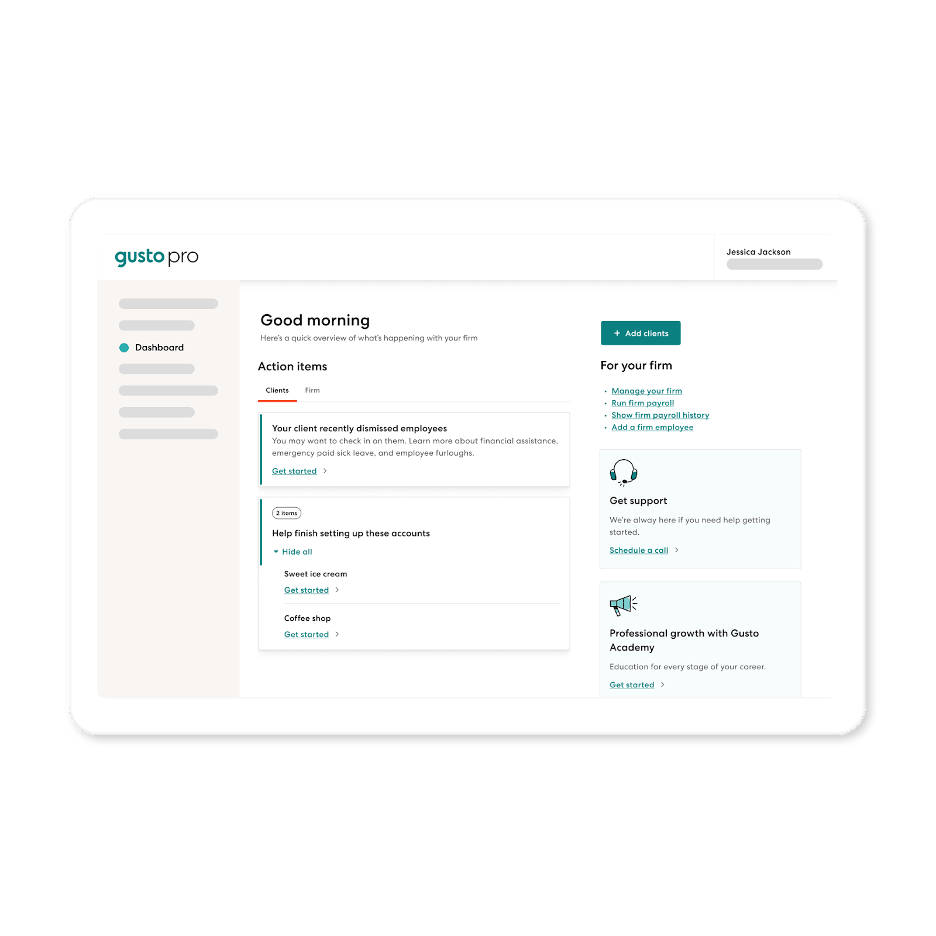
Ratings: G2 4.6/5 (8,010 verified reviews) | Capterra 4.6/5 (~4,137 reviews) Pricing: $49/month base + $6/person/month (Simple plan). Hiked 23% in March 2026. Month-to-month — no long-term contract required.
Gusto is a payroll, benefits, and HR tool built for US small businesses under roughly 100–150 employees.
What's included:
- Single-state payroll with automated federal, state, and local tax filings (Simple plan)
- Multi-state payroll requires the Plus plan ($80/mo + $12/pp)
- W-2 and 1099 processing
- Onboarding workflows, time-off tracking, and basic HR document storage
- Health insurance brokerage (available in many states) and 401(k) administration on any plan
What G2 and Capterra reviewers say:
Pros:
- Payroll runs in minutes once employees are set up, with tax filings handled automatically
- Intuitive enough that most teams don't need training
- Ranked #1 on G2's Highest Satisfaction Products list for 2026
Cons:
- Support slows down noticeably when tax errors or W-2 discrepancies come up
- The Simple plan jumped 23% in March 2026; international hiring through Gusto Global adds significant cost
Best for: Small businesses under 50 employees that want payroll, benefits, and basic HR in one place without a complicated setup. If you're comparing options, our guide to how to do payroll for small business is a good place to start.
BambooHR — Best small business HRIS for growing teams.
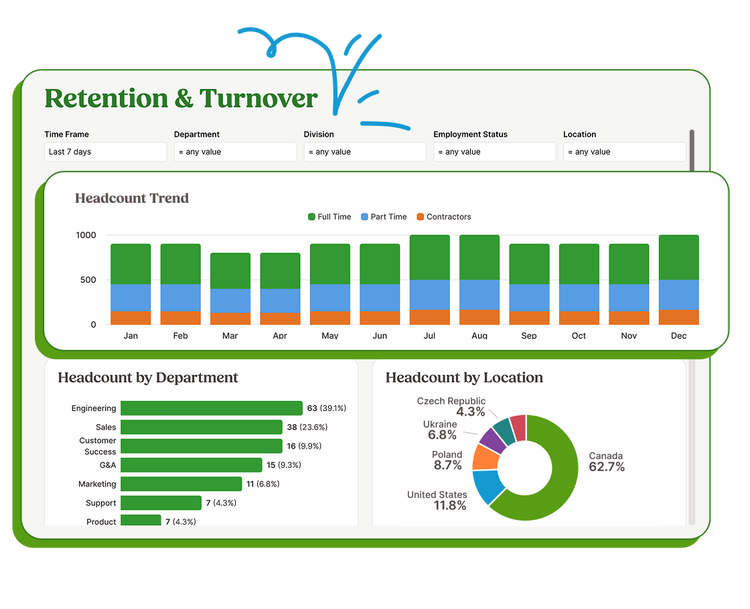
Ratings: G2 4.4/5 (5,641 verified reviews) | Capterra 4.6/5 (~3,447 reviews) Pricing: Core at $10/user/month, Pro at $17, Elite at $25 (for teams of 26+ employees). Teams of 25 or fewer pay a flat monthly rate starting at $250/month. Payroll and performance management are separate paid add-ons. Full pricing requires a quote.
BambooHR is an HRIS built for small and mid-sized businesses that have outgrown spreadsheets and need a real home for employee data.
Core capabilities:
- Employee records and self-service portal
- Document storage and time-off tracking
- Reporting and applicant tracking
- Onboarding automation: digital offer letters, e-signatures, and new hire packet workflows
What G2 and Capterra reviewers say:
Pros:
- HR managers and employees pick it up quickly; minimal training needed
- The new hire onboarding automation is one of the most praised features across both platforms
Cons:
- Payroll and performance management cost extra. They're not in the base plan.
- Reviewers frequently mention unexpected price increases at renewal
Best for: Small businesses in the 25–150 employee range that need a clean HR records system with strong onboarding. If the pricing structure gives you pause, check out BambooHR alternatives and our guide to employee onboarding software. If you're hiring your first employee, BambooHR's onboarding workflow alone can justify the cost.
Rippling — Best small business HR software for HR + IT automation.
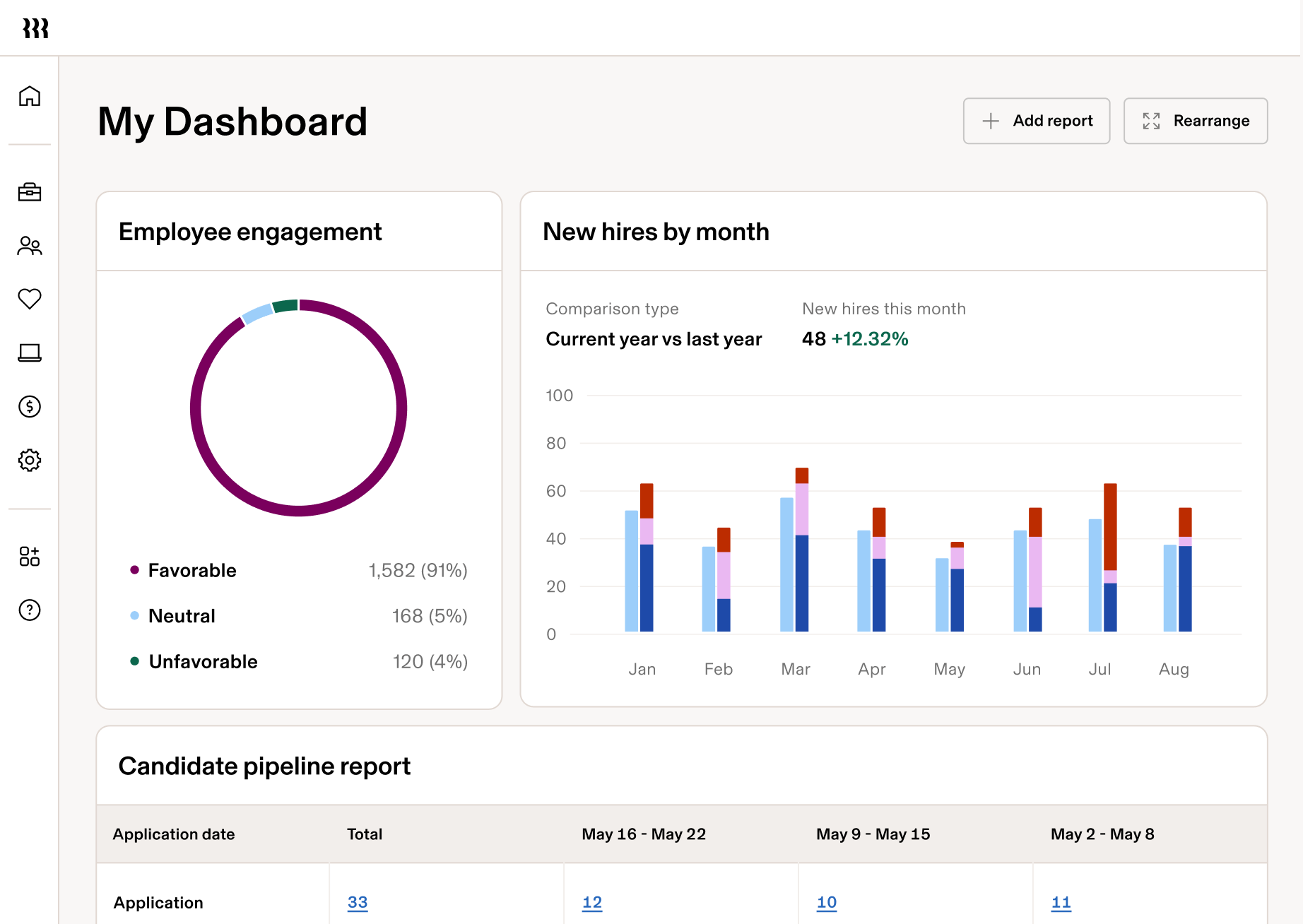
Ratings: G2 4.8/5 (12,000+ verified reviews) | Capterra 4.9/5 Pricing: Unity base starts at 8/user/monthplusabaseplatformfee(35–$40/month depending on configuration). Most teams land at 15–50+ per employee per month once payroll, benefits, IT, and time tracking modules are added. Full pricing requires a custom quote.
Rippling connects HR, payroll, IT, and finance in a single system. One employee record drives everything. When you hire someone, their payroll, app access, and device management all update at once.
What it automates:
- Payroll, app access provisioning, device management, and benefits from one record
- Day-one onboarding: laptop provisioning, app access, and payroll setup triggered at the same time
- Eliminates manual handoffs between disconnected tools, particularly valuable for teams managing HR, IT, and payroll separately
What G2 and Capterra reviewers say:
Pros:
- The most praised benefit: replacing five separate tools with one
- Automated day-one onboarding is the standout feature across 12,000+ G2 reviews
Cons:
- Pricing starts at $8/user but climbs to 30–50+ PEPM once modules stack up
- Phone support is only available for accounts with 150+ employees
- The initial setup takes real time to get right
Best for: Small-to-mid-size businesses (50–200 employees) juggling multiple tools they want to consolidate. If you have fewer than 10 employees, the setup complexity probably isn't worth it yet. Our guide to alternatives to ADP is worth a look if you're evaluating that category too.
Connecteam — Best free HR software for small business deskless teams.
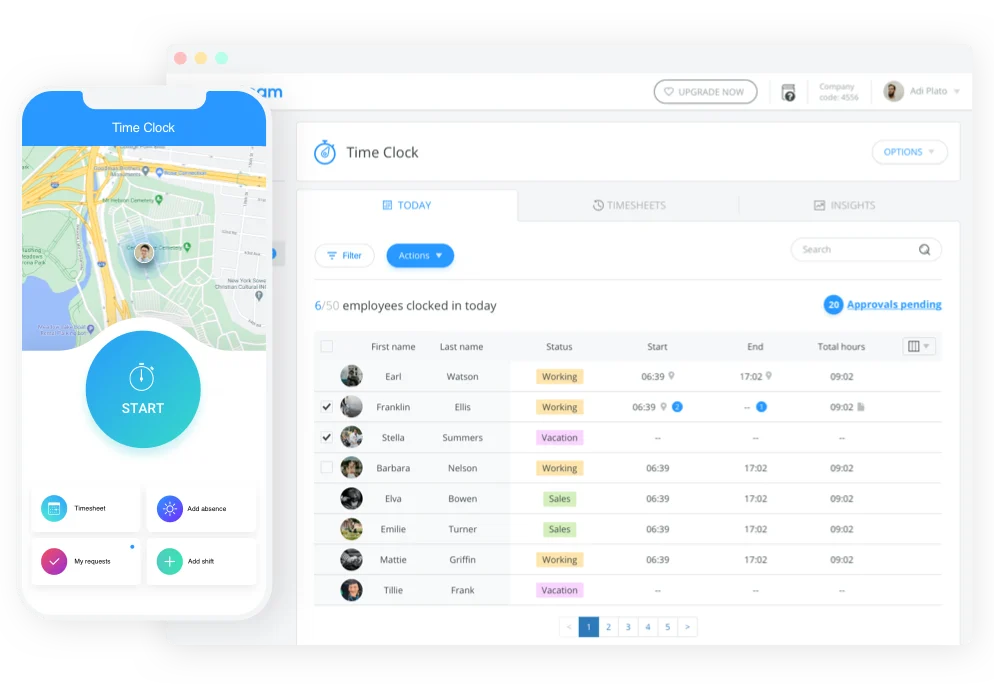
Ratings: G2 4.6/5 (3,500+ verified reviews) | Capterra 4.7/5 (300+ reviews) Pricing: Free for up to 10 users (fully functional). Basic plan: $29/month for up to 30 users (billed annually; $35/month on monthly billing). Advanced: $49/month (annually; $59/month monthly). Expert: $99/month (annually; $119/month monthly). HR, Operations, and Communications are separate "Hubs" — buying multiple hubs raises costs significantly.
Connecteam is a mobile-first app built for teams that don't work at a desk: the kind of crew that clocks in from a job site, a restaurant kitchen, or a retail floor.
Core capabilities:
- Drag-and-drop scheduling and AI-assisted shift building
- GPS-verified time tracking with geofencing
- Payroll-ready timesheets
- Team chat, task management, and digital forms
- Onboarding and PTO tracking (HR workflows)
Best fit industries: restaurants, retail stores, cleaning companies, home services, construction, and healthcare aides — anywhere most employees work away from a desk.
If you're looking for free HR software for small business, Connecteam's free tier is the real deal for teams under 10. It's also a strong pick if you need employee scheduling software, employee timesheets, and time tracking software without building a separate payroll stack.
What G2 and Capterra reviewers say:
Pros:
- Field teams adopt it without the usual pushback; that's one of the most consistent themes across reviews
- GPS time clock and shift scheduling get the strongest praise
- Customer support scores 9.1 on G2
- The free tier is described as exceptional value for small crews
Cons:
- Key features are locked behind higher-tier plans
- Costs add up fast when your team needs capabilities across multiple Hubs
- GPS tracking can be unreliable in low-signal areas
Best for: Deskless and field-based small businesses, and any team looking for free HR software for small business with a crew under 10.
OnPay — Best HR and payroll software for small business, flat rate.
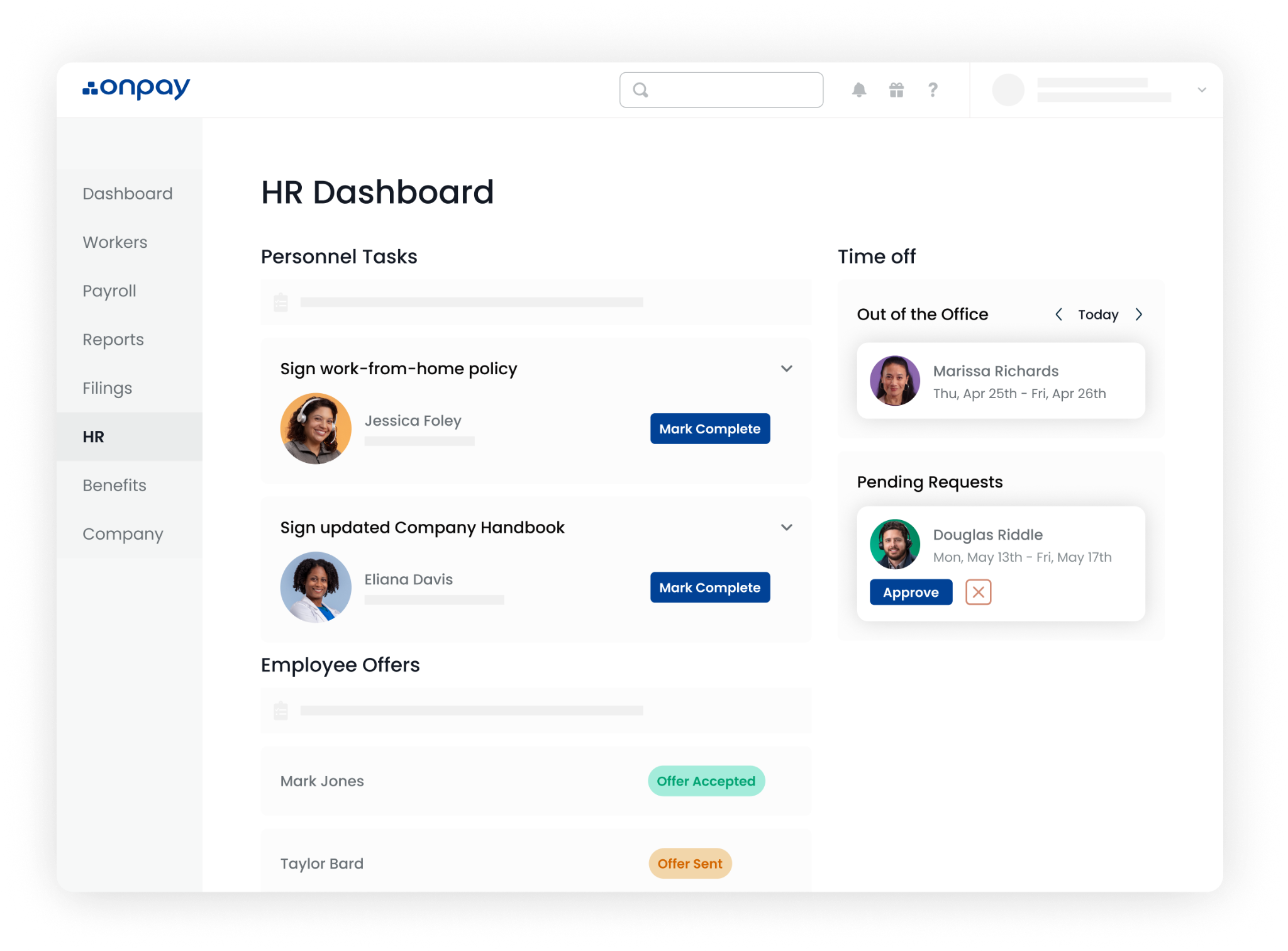
Ratings: G2 4.8/5 (406–413 verified reviews, ranked #1 in G2's Summer 2026 Payroll Results Index) | Capterra 4.8/5 (~465–468 reviews) Pricing: $49/month base + $6/person/month. Flat rate — no per-module add-ons for core features. Multi-state payroll included at no extra charge.
OnPay is payroll and HR software built for small businesses, accounting firms, and industries with genuinely complex payroll: restaurants with tipped workers, nonprofits, farms, and construction companies.
What's included in the base plan ($49/mo + $6/pp):
- Payroll for W-2 employees and 1099 contractors in all 50 states
- Automated federal, state, and local tax filings
- Accuracy guarantee: OnPay covers IRS penalties caused by their errors
- Onboarding workflows, document templates, self-service portal, and org charts
- QuickBooks and Xero integrations
Requires the HR add-on ($15/mo base + $2/worker): PTO management and document audits
What G2 and Capterra reviewers say:
Pros:
- Flat-rate pricing with no surprises at renewal is the feature reviewers mention most
- A real person calls new users within minutes of signing up, not an automated sequence
- Ranked #1 in G2's Summer 2026 Payroll Results Index for time-to-ROI (under 6 months vs. the 11-month category average) and implementation speed (live in roughly two weeks vs. two months on average)
Cons:
- Fewer third-party integrations than Gusto or Rippling
- PTO management costs extra above the base plan
- Reporting is more limited than enterprise-grade alternatives
Best for: Small businesses under 100 employees that want predictable payroll pricing with no module surprises. If you're figuring out payroll for the first time, OnPay's onboarding support is genuinely helpful. See our guide on how to run payroll for context.
How to Compare HR Software for Small Business Side by Side
When you're comparing HR software for small business, don't just look at the headline price. Per-module add-ons can triple the sticker cost of any HR management software for small business once you add what you actually need. Model the all-in cost before you commit.
G2 and Capterra ratings are a good starting point, but pricing opacity is one of the most common complaints in this category. Here's what else to look at.
Gusto: Payroll-first. Transparent pricing ($49/mo base + $6/pp, Simple plan — single-state; Plus plan required for multi-state at $80/mo + $12/pp). Benefits brokerage available. HR depth becomes limited above 100–150 employees.
BambooHR: HRIS-first. Per-user pricing (10–25/user/mo for teams of 26+; $250/mo flat for smaller teams). Payroll is a paid add-on. Strong onboarding workflows. Best for 25–150 employees.
Rippling: HR + IT unified. Modular pricing (starts $8/user/mo, climbs quickly). Automation-heavy. Best for 50–200 employees with software stacks to consolidate.
Connecteam: Deskless and mobile-first. Free tier for up to 10 users, $29/mo for up to 30 (annually). Features vary by Hub tier. Best for field teams and deskless workers.
OnPay: Flat-rate payroll + HR ($49 + 15/mo base + $2/worker). Best for restaurants, retail, and nonprofits with tipped workers.
If none of these feel right, our comparison of Gusto alternatives and our guide to employee scheduling are good places to keep looking.
Choosing the Right Small Business HR Software
The best HR software for small business is the one that solves your actual bottleneck.
Before committing to any HR software for small business, test the mobile app with a few employees. Adoption on the ground floor matters as much as features on paper: if your team won't use it, the specs don't matter.
If your team clocks in and out for shifts, a generic HR tool won't cover your employee scheduling or time tracking, and you'll end up paying for multiple apps anyway. Start with Homebase free and bring it all together.
FAQs about HR Software for Small Business
What is the best HR software for small businesses
The best HR software for small businesses depends on your primary need. Gusto leads for payroll-first teams, BambooHR for HRIS and onboarding, Rippling for HR + IT automation, Connecteam for deskless and hourly teams, and OnPay for flat-rate payroll with no module upsells. Most small businesses under 50 employees do well with Gusto or OnPay as a starting point.
Is there free HR software for small businesses
Free HR software for small businesses does exist, though it comes with trade-offs. Connecteam offers a fully functional free plan for teams of up to 10 users, covering scheduling, time tracking, and team communication. Most other options (Gusto, BambooHR, OnPay) require a paid subscription, though free trials are typically available.
What is a small business HRIS
A small business HRIS (Human Resources Information System) is software that centralizes employee data, documents, time-off tracking, onboarding workflows, and reporting in one place. Unlike payroll-only tools, an HRIS like BambooHR manages the full employee record from hire to separation. Most small businesses find they need one once they hit 25–50 employees and HR administration gets too complex for spreadsheets.
What HR software for small business works best for restaurants and retail
HR software for small business in restaurants and retail needs to handle tipped worker payroll, tip pooling, and multi-state compliance alongside scheduling and time tracking. OnPay is a strong choice for tipped worker payroll. Connecteam covers scheduling and time tracking for shift-based teams. Homebase brings scheduling, time tracking, and payroll together in one app built specifically for hourly teams in restaurants, retail, and similar businesses.
How much does HR software for small business cost
HR software for small businesses ranges from free (Connecteam for teams under 10) to 6–25 per employee per month on mid-tier platforms. Gusto and OnPay both start at $49/month plus $6/person. BambooHR starts at $10/user/month (or $250/month flat for teams of 25 or fewer). Rippling starts at $8/user/month but can reach 30–50+ per employee per month with full modules. Always verify the all-in cost with add-ons before you sign up.

Carissa is the SEO + GEO Managing Editor at Homebase, with 13 years of experience in content marketing and SEO strategy. She’s created foundational guides on starting a business, navigating payroll, and managing teams, and helped solo lawyers, artists, and creative entrepreneurs grow their web presence and organic traffic.

.webp)
Carissa is the SEO + GEO Managing Editor at Homebase, with 13 years of experience in content marketing and SEO strategy. She’s created foundational guides on starting a business, navigating payroll, and managing teams, and helped solo lawyers, artists, and creative entrepreneurs grow their web presence and organic traffic.
